
.png/:/cr=t:0%25,l:0%25,w:100%25,h:100%25/rs=w:370,cg:true)
.png/:/cr=t:0%25,l:0%25,w:100%25,h:100%25/rs=w:370,cg:true)

Rethinking the Architecture of Apple Stores
Apple's current retail architecture—though elegant and technically refined—often emphasizes brand uniformity over contextual relevance. While their flagship stores are minimal, sleek, and material-conscious, they largely replicate a commercial typology rather than evolve it. Many stores prioritize visual consistency and digital branding over spatial diversity, limiting the potential of architecture to provoke wonder or invite new kinds of urban interaction.
This project critiques that tendency, envisioning an Apple Experience Centre in Dubai not just as a retail design destination, but as an architectural icon—bold, sculptural, site-specific, and civic-minded. It proposes a speculative architecture that reflects the ambition and symbolism of the brand itself.
Site Selection: Creek Harbour Central Park
We analyzed several potential sites in Dubai, including Business Bay and Dubai Design District (D3). Business Bay, while active and central, lacked a coherent pedestrian rhythm, with disconnected waterfronts and fragmented urban frontage. In contrast, D3 showcases impressive Dubai architecture with stronger spatial cohesion and beautiful water views, but currently suffers from limited foot traffic and activation, which impacts its retail design potential.
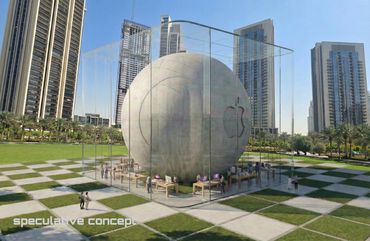
Creek Harbour’s Central Park presents a compelling paradox: calm and residential in the present, yet positioned to become a vibrant cultural node once Dubai Square opens. This area is ripe for speculative architecture, with its open green landscape, generous setbacks, and skyline backdrop creating a powerful canvas for architectural experimentation and urban interaction.
Concept: A Dialogue of Form, Material, and Brand
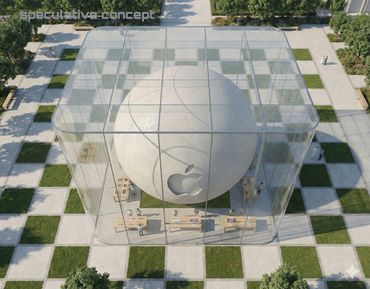
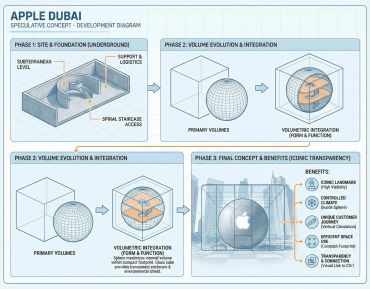
The core concept behind the Apple Experience Centre is radical in its simplicity: a concrete sphere cradled inside a transparent glass cube. This tension between the heavy and the light—between raw mass and absolute clarity—forms the architectural soul of the project, embodying the principles of innovative Dubai architecture.
The tactile and monumental concrete sphere symbolizes durability, protection, and inner strength—qualities that resonate with Apple’s values around product security, privacy, and technological reliability. In contrast, the glass cube represents transparency, openness, and trust—the public-facing clarity of Apple’s retail design and design language.
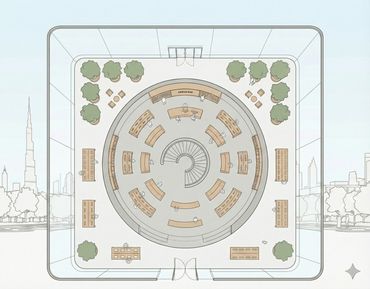
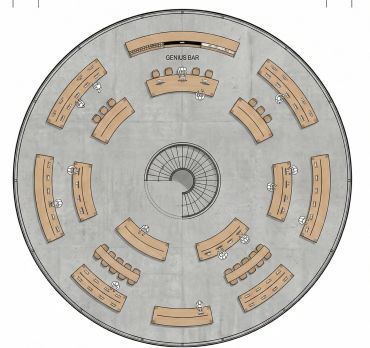
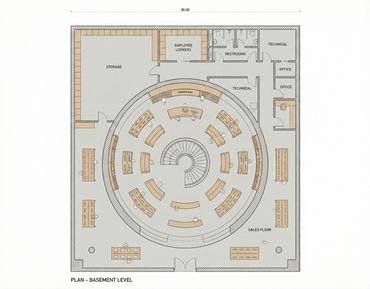
Visitors circulate through a spiral staircase that wraps around the inner core, offering dynamic perspectives on both architecture and products, a hallmark of speculative architecture. The sphere houses multiple experience levels, while the transparent cube extends the park’s geometry inward—blurring the line between interior and exterior, product and public, brand and city, fostering a sense of urban interaction.
Together, these elements redefine the Apple retail experience as something closer to cultural infrastructure—where form, meaning, and experience are inseparable.
Strategic Value — Why Apple Should Invest, and Why Dubai is the Right Place
This proposal offers more than iconic form—it represents a strategic cultural investment. For Apple, this is an opportunity to enhance its global brand presence in a region where architecture is powerfully symbolic. Instead of replicating existing retail formats, the Apple Experience Centre becomes a destination in itself—a place of pilgrimage, akin to an art museum or tech temple. It deepens customer engagement through spatial experience, not merely product interaction. Dubai's high tourism numbers, tech-savvy population, and its status as a regional business hub make it a compelling setting for Apple to anchor its brand in the Middle East with unprecedented boldness.
For Dubai, the project contributes a new typology to its urban and cultural landscape: not just another commercial flagship, but a civic-tech landmark that exemplifies innovative retail design. Sited within Creek Harbour’s Central Park, it activates the public realm, strengthens the identity of a rapidly growing district, and reinforces Dubai’s reputation as a host of architectural innovation. At the intersection of commerce, culture, and speculative architecture, this project reflects the city’s evolving ambitions—and gives global audiences a reason to visit again.